Why Is It Called Tarpaulin
Why is it called tarpaulin?
PVC knife-coated tarp fabric stands as an indispensable high-performance composite material in modern industrial manufacturing, outdoor covering, advertising printing, architectural membrane structures, and numerous other fields. With its outstanding waterproofing, tear resistance, aging resistance, and self-cleaning properties, PVC tarp occupies a dominant position in the premium tarpaulin and coated fabric markets. Many users wonder: When did this exceptional tarpaulin fabric first emerge, and what developmental journey did tarp undergo? And where does the evocative name "knife-coated fabric" originate?
To understand PVC knife-coated fabric, one must first trace its origins back to its predecessors—traditional canvas and early coated textiles. Canvas boasts a long history, dating back to ancient Rome. Medieval Nordic Vikings used canvas for ship sails, relying on the woven structure of cotton and linen fibers to provide wind and water resistance. However, traditional canvas had significant drawbacks: traditional canvas was heavy, absorbed water easily, was prone to mold, and had poor weather resistance, leading to decay and damage during prolonged outdoor use. With the advent of the industrial era, rubber-coated canvas and oilcloth emerged, offering improved waterproofing. Yet these materials still struggled to address issues like aging, cracking, and cumbersome maintenance, failing to meet the demands of modern high-intensity applications.

In the early 20th century, the industrial production of polyvinyl chloride (PVC) materials in the chemical industry ushered in the first technological revolution for coated fabrics. Europe pioneered the use of PVC resin for fabric coating, introducing early PVC-coated fabrics. These featured polyester base fabric as the skeleton, with PVC paste coated on both sides, significantly enhancing waterproofing and UV protection. Coating techniques during this period primarily relied on dip coating and brush coating. These methods resulted in uneven coating thickness and weak adhesion, often leading to delamination and peeling. They fell significantly short of the mature knife-coating process that would later emerge. Nevertheless, this step laid the material foundation and established the technological direction for the subsequent development of knife-coating technology.
In the mid-20th century, demand for high-end tarpaulins and membrane structures surged across Europe. Ships, trucks, open-air warehouses, and large venues demanded fabrics with enhanced tensile strength, thicker coatings, and more stable structures. Traditional coating processes struggled to achieve uniform coverage of thick layers and high adhesion strength, leading to the emergence of knife coating technology. This process employs precision blade devices to sequentially apply layers of high-temperature plasticized PVC paste onto the base fabric surface. The paste fully permeates the fiber gaps before undergoing high-temperature curing and forming, fusing the coating with the base fabric into a single entity. This completely resolves issues like delamination, adhesive failure, and coating leakage. With its overwhelming performance advantages, the knife coating process swiftly became the mainstream technology for high-end PVC-coated fabrics, marking the official debut of PVC knife-coated fabrics on the industrial stage.

During the 1980s and 1990s, PVC knife-coated tarp fabric technology was introduced to China from Europe. Domestic enterprises were the first to import production lines and commence localized manufacturing. Early products primarily targeted export markets and high-end industrial applications, characterized by high costs and limited usage. As domestic capabilities in chemical engineering, textiles, and machinery manufacturing advanced, domestic production of knife coating equipment, PVC paste formulations, and base fabric weaving technology gradually became feasible. This led to reduced costs and expanded production capacity. PVC knife-coated tarpaulin began entering civilian applications such as truck tarps, warehouse covers, and advertising banners, rapidly replacing traditional coated fabrics, PE fabrics, and silicone fabrics to become the market mainstream.
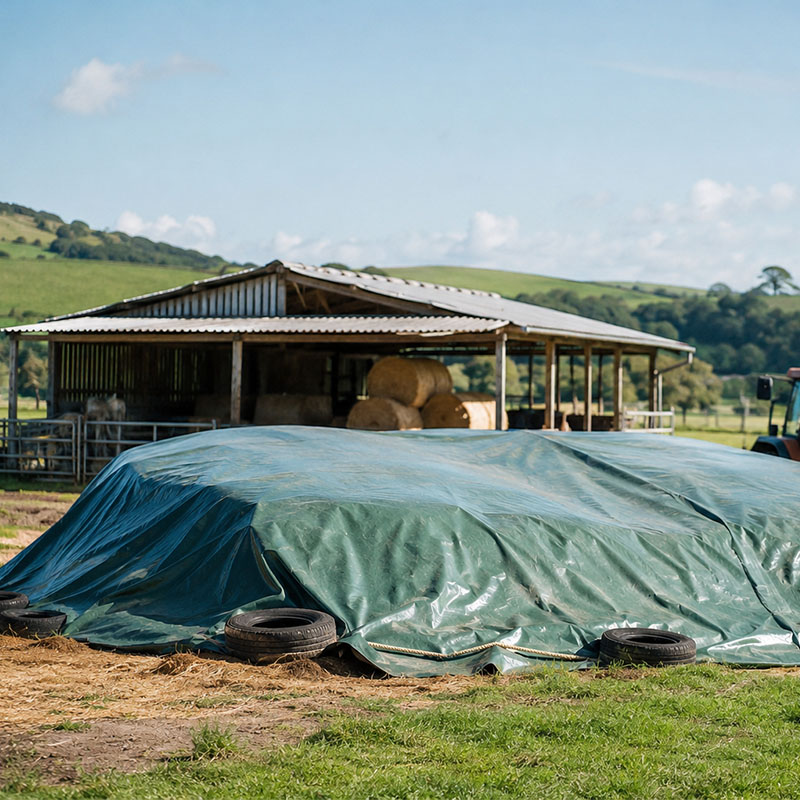
Entering the 21st century, PVC knife-coated tarpaulin fabric entered a mature development phase. Technologically, PVC tarp advanced from single-knife coating to dual-knife and multi-knife continuous coating, achieving more uniform thickness and higher density. The base fabric upgraded from standard polyester filament to high-strength polyester industrial filament, significantly boosting tensile strength. Functionally, PVC waterproof tarpaulin has continuously expanded to incorporate flame retardancy, cold resistance, high-temperature resistance, anti-static properties, self-cleaning capabilities, and black-out light blocking, forming a comprehensive product system. Today, PVC knife-coated tarp fabric is widely used in truck covers, open-air storage, construction site protection, livestock barn curtains, inflatable products, outdoor light boxes, tensioned membrane structures, and other applications, establishing itself as a representative high-performance composite material.
Historically, the development of PVC knife-coated tarp fabric epitomizes the synergistic advancement of materials science, textile technology, and chemical engineering. Breaking through the limitations of traditional canvas, PVC fireproof tarp achieved a performance leap through the combination of PVC materials and knife-coating techniques. What began as a high-end specialty material in Europe has evolved into a globally ubiquitous industrial and consumer product. Regarding its nomenclature, "knife-coated fabric" is named after its manufacturing process—a straightforward and intuitive designation that has become the industry's standard terminology. This naming convention bears witness to the evolution of coated fabrics: from crude to refined, and from low-end to high-end applications.
Today, with heightened environmental standards and technological advancements, eco-friendly PVC and TPU knife-coated fabrics—free of plasticizers, low-odor, and recyclable—are gradually emerging, while the knife-coating process continues to be refined. Yet regardless of technological advancements, PVC knife-coated tarp fabric maintains an irreplaceable role in covering, protection, decoration, construction, and other fields due to its stable and reliable performance. Its history reflects the evolution of industrial materials adapting to market demands through continuous self-innovation; its name stands as a vivid testament to the imprint of process innovation on the product itself.
What Are The Benefits Of Using Heavy-duty Tarps
What Type of Tarp Is Most Fireproof
Related Article