Is PVC Tarp Suitable for High Speed Door
Is PVC Tarp Suitable for High Speed Door ?
In today’s industrial and commercial environments, high-speed doors serve as critical infrastructure for enhancing logistics efficiency and optimizing work environments, making the choice of curtain material of paramount importance. As a high-performance composite material, PVC tarp fabric offers significant advantages in high-speed door curtain applications due to its unique physical and chemical properties, making it the material of choice across numerous industries for improving production efficiency and operational quality.

I. High Strength and Durability: Designed for Frequent Opening and Closing
PVC knife-coated fabric is produced by uniformly applying liquid PVC to a polyester woven fabric using a knife-coating process, forming a dense, waterproof layer. Its tensile strength reaches 5,700 N/5 cm (warp direction) and 5,100 N/5 cm (weft direction), while its tear strength reaches 900 N (warp direction) and 80 N (weft direction). These high-strength properties enable the material to withstand the mechanical stress caused by the frequent opening and closing of high-speed doors. Even under extreme conditions involving thousands of cycles per day, PVC tarp maintains structural stability, avoiding the increased maintenance costs associated with fatigue fractures in traditional door curtains. For example, in the passageways of automotive manufacturing plants, high-speed doors must open and close multiple times in a short period to match the production line’s rhythm. The durability of PVC knife-coated tarp door curtains ensures long-term, trouble-free operation of equipment, reducing downtime losses.
Additionally, PVC knife-coated tarp has a temperature resistance range of -30°C to +70°C, making it suitable for extreme climatic conditions. In cold northern regions, low winter temperatures will not cause the curtain to become brittle or crack; in hot southern environments, intense summer sunlight will not cause the material to deform, thereby extending the curtain’s service life.

II. Excellent Physical and Chemical Stability: Ensuring Suitability for Complex Environments
The chemical stability of PVC tarp curtains is demonstrated by their resistance to oxidation, acids, alkalis, and corrosion. In industries such as chemicals and pharmaceuticals, where environmental cleanliness standards are extremely high, high-speed doors are frequently exposed to corrosive gases or liquids. Traditional curtain materials are prone to performance degradation due to chemical erosion, whereas PVC tarp curtains can form a protective layer through the addition of UV stabilizers and anti-aging agents, effectively blocking the penetration of chemical substances. For example, in electronic component production workshops, PVC tarp fabric door curtains prevent acid mist from corroding equipment while also preventing static electricity from attracting dust, thereby maintaining dust-free environmental standards.
PVC tarp’s waterproof performance is equally outstanding, with a water absorption rate of less than 0.1%. Combined with high-density weaving techniques and surface coating treatments, PVC tarp can completely block moisture penetration. At the entrances and exits of cold storage facilities in food processing plants, PVC tarp fabric door curtains prevent condensation from dripping and contaminating products, while also resisting the intrusion of external rainwater, ensuring stable indoor temperatures.

III. Rapid Opening/Closing and Sealing Performance: Enhancing Logistics Efficiency and Energy Savings
The core value of high-speed doors lies in their “high-speed” capability, and the lightweight design of PVC tarp curtains (with a density of just 1.38 g/cm³) makes them an ideal material for achieving rapid opening and closing. Compared to traditional steel roll-up doors, PVC tarp slat curtains can open and close 20 times faster, shortening the time the entrance remains open and reducing air exchange between the interior and exterior. In logistics warehouses, this feature accelerates cargo loading and unloading processes, prevents logistics congestion caused by doors remaining open for too long, and improves overall operational efficiency.
In terms of sealing performance, the bottom of PVC tarp fabric door curtains is typically equipped with an elastic PVC backing that conforms tightly to uneven floors, achieving a Class 10,000 air cleanliness standard. Sealing brushes or rubber strips installed on both sides of the door frame further reduce noise and enhance the sealing effect. Some high-end products feature a dual-track design with sealing strips installed at the top and bottom, creating a fully enclosed structure that effectively prevents dust, insects, and odors from entering the room. In cleanrooms at pharmaceutical companies, this sealing performance helps maintain air quality standards, reduces energy consumption of HVAC systems, and achieves energy-saving and emission-reduction goals.

IV. Safety and Environmental Features: Compliant with Modern Industrial Standards
Safety is a fundamental requirement in the design of high-speed doors. By incorporating flame retardants, PVC tarp curtain door panels meet the fire resistance requirements of French standard NF-P92-503 Class M2 or German standard DIN 4102 Class B1. In the event of a fire, tarp high speed doors delay the spread of flames, buying valuable time for personnel evacuation. Additionally, their smooth surface prevents sharp edges from injuring operators, thereby reducing the risk of workplace injuries.
In terms of environmental protection, high-quality PVC tarp curtains are manufactured from recyclable materials and comply with the RoHS Directive’s restrictions on heavy metal content. PVC tarp curtains can be recycled after disposal, reducing environmental pollution. Furthermore, their self-cleaning surface prevents dust accumulation, reducing the frequency of cleaning and further minimizing water consumption and the use of chemical cleaning agents.

V. Customization and Cost-Effectiveness: Meeting Diverse Needs
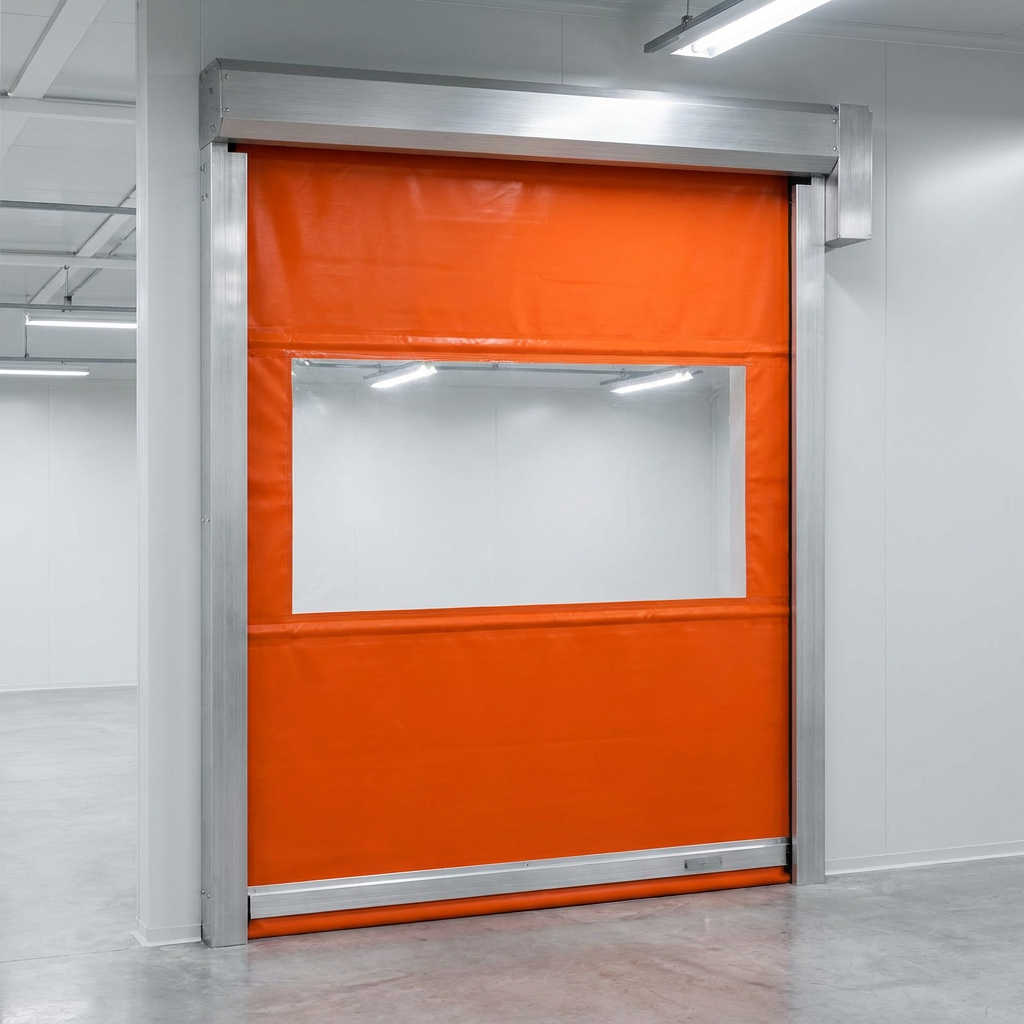
PVC knife-coated tarp fabric supports customized production in terms of thickness (0.35–1.50 mm), width (up to 3.5 meters), and color, accommodating the visual design requirements of various settings. For example, at shopping mall entrances and exits, transparent or semi-transparent door curtains can enhance the sense of openness in the space; in industrial facilities, orange or yellow door curtains can improve warning visibility and help prevent collision accidents.
From a cost-effectiveness perspective, while the initial cost of PVC knife-coated tarp fabric door curtains is slightly higher than that of standard PVC materials, their service life can reach 5–8 years—far exceeding that of traditional canvas (2–3 years) and rubber door curtains (3–4 years). Long-term use significantly reduces replacement frequency and maintenance costs. This advantage is particularly pronounced for high-speed doors that open and close frequently.
Thanks to its comprehensive advantages—including high strength, corrosion resistance, rapid opening and closing, excellent sealing performance, and safety and environmental friendliness—PVC tarp fabric has become the ideal choice for high-speed door curtains. From food processing to logistics and warehousing, and from electronics manufacturing to pharmaceutical production, its performance has been proven in the market. In the future, with ongoing innovations in materials technology, PVC tarp fabric will undergo further upgrades toward greater intelligence and energy efficiency, providing stronger support for efficient production in the Industry 4.0 era.
What kind of tarp can hold water
Where to Buy Large Tarps for Roofing
Related Article