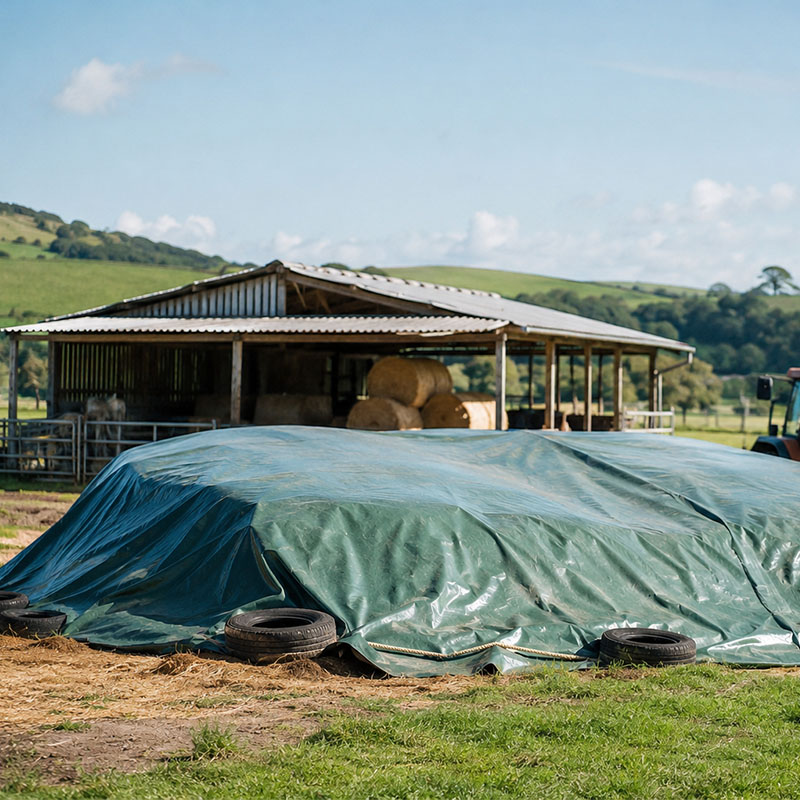
Why PVC Tarp Can Perfectly Protect Your Hay
Why PVC Tarp Can Perfectly Protect Your Hay ?
In modern livestock farming and forage production, hay serves as a core forage resource, and its storage quality directly determines both production costs and animal health. Traditional methods such as open-air stacking and rudimentary covering often results in hay becoming damp and moldy, losing nutrients, and being infested by insects and rodents, leading to significant economic losses.

Hay has extremely poor storage stability, and even minor changes in the external environment can cause irreversible damage. First is moisture damage: rain, dew, and water from melting snow seep into the bales, causing the moisture content to exceed safe levels and triggering mold growth. This not only reduces nutritional components such as crude protein and vitamins but also produces harmful substances like aflatoxins, leading to livestock poisoning, diarrhea, and other health issues. Second is UV degradation. Prolonged exposure to sunlight breaks down the hay’s fiber structure, causing leaves to fall off and nutrients to evaporate, while also accelerating the brittleness and deterioration of standard covering materials.
In addition, severe weather conditions such as strong winds and hail can cause hay bales to scatter and suffer physical damage, while gnawing and contamination by rodents, birds, and insects can also significantly reduce hay utilization rates. Traditional covering materials, such as canvas and PE film, either lack sufficient waterproofing and are prone to leaks, or have low tear resistance and a short service life, making them unsuitable for long-term outdoor storage. Against this backdrop, PVC tarpaulins, with their comprehensive protective capabilities, effectively address the various challenges associated with hay storage.
- A dense, waterproof coating that blocks moisture intrusion at the source
PVC tarpaulins feature a base fabric made of high-strength polyester filament yarn, coated on both sides with a polyvinyl chloride (PVC) waterproof coating. Through a high-temperature heat-sealing process, a continuous, dense polymer barrier layer is formed on the surface. This structure offers zero-permeability waterproofing. Rain and snow falling on the tarpaulin surface form water droplets that roll off quickly without penetrating the interior. Additionally, the coating’s air-tightness prevents moisture in the air from diffusing, thereby preventing hay from becoming damp due to moisture absorption.
Compared to standard PE tarps, which are prone to tearing and leaking, and canvas, which absorbs moisture and becomes damp, PVC tarps offer superior waterproofing and durability, making them ideal for long-term outdoor use. In regions with heavy rainfall and high humidity, hay covered with PVC tarps can maintain a moisture content consistently below 15%—a safe threshold—effectively preventing mold growth and ensuring the safety of the forage.
- Professional UV-resistant formula that protects against photo-aging and nutrient loss
High-quality PVC tarpaulins are manufactured with highly effective UV absorbers and light stabilizers, filtering out over 90% of harmful UV rays. On one hand, this protects the tarpaulin itself from aging, preventing brittleness and powdering caused by prolonged exposure to sunlight, and extending its service life to 3–5 years. On the other hand, PVC tarp hay cover blocks UV damage to hay, preventing the degradation of hay fibers and the withering and shedding of leaves, thereby preserving core nutrients such as crude protein and minerals.
- High physical strength to withstand extreme weather and external damage
The base fabric of PVC tarpaulins is made using a high-density weaving process, which, combined with the flexibility of the PVC coating, provides excellent tensile strength, tear resistance, and puncture resistance. In high-wind conditions, the tarpaulin can withstand strong wind pressure without tearing or being blown away. When weighted down and secured with straps, PVC tarp cover firmly wraps around hay bales, preventing them from scattering. Even under external impacts such as hail or scrapes from tree branches, PVC knife-coated tarp cover is resistant to punctures, maintaining its protective integrity.
At the same time, PVC tarpaulins offer outstanding resistance to both high and low temperatures. PVC knife-coated tarp hay cover do not soften or emit odors in the summer heat, nor do they harden or crack in the winter cold. Hay tarp cover are well-suited to the diverse climatic conditions of both the north and south of the country, providing reliable protection whether during the rainy season in the south or the harsh winters in the north.

- Mold-proof, antibacterial, and pest-resistant—comprehensive protection for forage hygiene
The smooth, dense surface of the PVC coating does not attract dust or harbor mold, and it possesses antibacterial properties that inhibit the growth of mold and bacteria. Additionally, the sealed covering prevents rodents, birds, and insects from entering, thereby avoiding damage from gnawing and contamination from droppings, which reduces forage loss and the risk of disease transmission. Compared to open-air stacking, the loss rate of hay covered with PVC tarps can be reduced by more than 80%.
With its comprehensive advantages—including waterproofing, moisture resistance, resistance to aging, high strength, durability, and protection against mold and pests—PVC tarpaulin provides a comprehensive protection system for hay storage. For livestock farmers and forage operators, selecting high-quality PVC tarps and using them properly can not only reduce hay loss and preserve forage nutrients, but also lower production costs and improve profitability.
How to Protect a Vehicle or RV When Stored Outdoors
How Can A Simple Tarp Make Landscaping So Easy
Related Article